Last Updated: 02.10.2026
EVENT CAPTAINS: Greg McConville and Chad Walber
ON-SITE LOCATIONS: North of the Fuel Station
PURPOSE OF NOISE TESTING
The Noise Test verifies that your vehicle meets sound limits required to compete in dynamic events. This test is mandatory and must be completed in the correct sequence to assure a safe and enjoyable event for all who participate.
BEFORE YOU COME TO NOISE
Your vehicle will not be allowed into Noise testing unless both of the following are complete:
- Tech Inspection – PASSED with sticker applied to car
- Tilt Table Test – PASSED with sticker applied to car
- Bring tech sheet with engine bore, stroke, and ALL other pertinent details filled in
WHAT WILL HAPPEN AT THE NOISE TEST
Noise testing is performed on a warmed-up vehicle at a designated test station. Teams will be allowed to warm their vehicle up in advance in the noise test prep area. Hot passes are required to enter this space.
The two noise tests will be performed with:
- The driver fully suited and all safety gear in place, sitting in the car
- Engine running with transmission in neutral
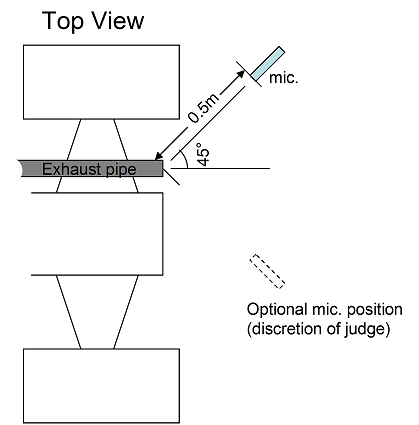
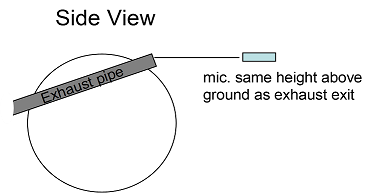
- Sound meter placed 0.5 meters from the exhaust outlet, level with the outlet
- Microphone positioned at up to 45°, unobstructed
All microphone positioning is at the discretion of the official.
For dual exhaust systems, both outlets are tested. The loudest reading is the one that counts.
THE TWO-STEP NOISE TEST
You must pass both steps to earn the Noise sticker.
Step 1: Idle Test
- Engine at idle
- Maximum allowed: 103 dBC
- If the car is 103 dBC or less, the next test is performance
- If you fail at idle, you must exit the noise test station, but may be pushed to a work space within the noise event area to modify the vehicle before retesting
Step 2: Run-Up Test (only if idle is passed)
- Engine at the designated test speed
- Maximum allowed: 110 dBC
- The test speed is approximately 3/4 of your engine’s maximum speed, calculated using the SAE-published formula
- Test speeds are rounded to the nearest 500 RPM and are published in advance
If the vehicle did not pass both tests, the vehicle may be pushed from the test station to a work space within the noise event area to modify the vehicle before retesting.
VERY IMPORTANT – TACHOMETER & ENGINE SPEED
- If your car does not have a working tachometer, it is the team’s responsibility to bring a laptop that can display the actual engine speed
- All teams must hit the target test speed
- If you have a rev limiter, it must be disabled or set high enough to reach the required speed
- Any exception to the test speed must be pre-approved by Tech and documented
OFFICIAL DECISIONS
- Sound meters are calibrated and checked regularly
- Meter placement and readings by officials are final and are not open to protest or debate
AFTER YOU PASS
- You will receive the Noise Compliance sticker
- You may then proceed to the Brake Test
ONGOING NOISE ENFORCEMENT
Noise levels may be checked at any time during dynamic events, and if your car exceeds the limit your Noise sticker may be removed. You must then return to noise for re-certification!
- There are no tests available on Saturday for re-cert!
Re-certification may also be required if:
- Exhaust work is performed
- The car is damaged in an on-track incident
NOISE AREA SAFETY RULES
- Minimum 3 workers recommended at the station
- Never stand in a vehicle’s line of travel
- Stay clear of “hot” areas of the vehicle
- Fire extinguishers must be present with the car and crew
- Keep the area clean and dry (use brooms and oil-dry as needed)
- Report any vehicle damage or contact immediately to station management
- Event Volunteers will come to you when it is your turn to test. Do Not approach Noise Event Volunteers during a vehicle test.